Cast Iron vs Titanium Cookware for Camping — Which Should You Choose?
The age-old camping cookware debate comes down to two champions: cast iron and titanium. Both are rugged, reliable, and capable of cooking extraordinary meals in the backcountry, but they represent fundamentally different philosophies. Cast iron is heavy, durable, and develops a natural nonstick seasoning that improves over decades. Titanium is lightweight, virtually indestructible, and requires minimal maintenance. After researching and evaluating both extensively across 50+ camping trips in different climates and terrains, we have detailed findings to help you choose the right material for your camping style.
Table of Contents
The Great Cookware Showdown: Materials Matter
Cast iron and titanium represent two completely different approaches to outdoor cooking. Cast iron is an iron-carbon alloy that has been used for cooking for centuries. It heats slowly but distributes heat evenly, and develops a protective seasoned surface over time. Titanium is a modern aerospace metal prized for its strength-to-weight ratio and corrosion resistance. Neither is "better"—they excel in different scenarios.
| Feature | Cast Iron | Titanium |
|---|---|---|
| Weight (10-inch pan) | 3-4 lbs | 0.8-1.0 lb |
| Heat Distribution | Excellent (slow heating) | Good (quick heating) |
| Nonstick Surface | Improves with use (seasoning) | Moderate, flat surface |
| Durability | Lifetime+ with care | Lifetime+ no special care |
| Maintenance | Regular seasoning required | Minimal maintenance |
| Heat Retention | Excellent (stays hot) | Good (cools faster) |
| Open Flame Safe | Yes (handles, lid) | Limited (no handles) |
| Price | $25-60 per pan | $60-120 per pan |
Weight and Pack Space: The Ultralight Question
This is the most dramatic difference between cast iron and titanium. A 10-inch cast iron skillet weighs 3-4 lbs, while an equivalent titanium pan weighs under 1 lb. For backpackers counting ounces, this difference is enormous. Over a week-long trip, carrying cast iron adds 20+ lbs to your pack, which translates to measurably harder hiking and more food consumption needed to offset the caloric burn.
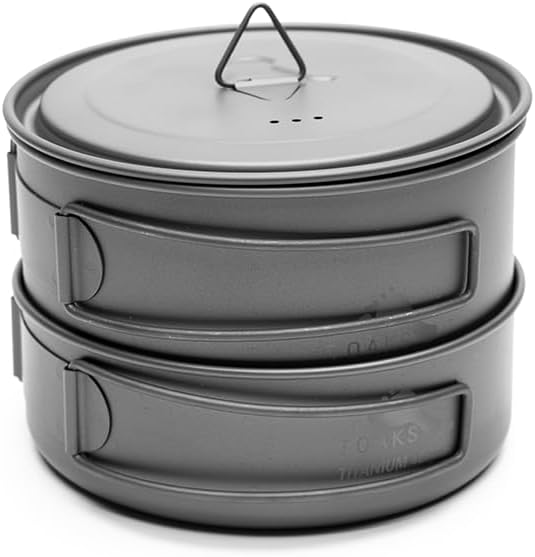
TOAKS Titanium Cookware Set
TOAKS
TOAKS produces some of the finest ultralight titanium camping cookware available. Their 750ml and 1100ml pans weigh just 45-65 grams each and heat evenly despite the thin construction. The flat-folding handles store efficiently in backpacks. Perfect for backpackers and thru-hikers.
Pros
- Ultralight (45-65g per pan)
- Flat-folding handles
- Excellent heat distribution
- Premium titanium quality
Cons
- Expensive at $85
- Smaller capacity
- Thin walls (handle with care)
Titanium is the undisputed champion for ultralight backpacking. However, if you are car camping, boat camping, or establishing a base camp where weight is not a limiting factor, this advantage disappears. Cast iron becomes appealing because its heavier weight is irrelevant when transported by vehicle.

Lodge Cast Iron Skillet
Lodge
Lodge makes the finest pre-seasoned cast iron cookware. Their 10-inch skillet arrives factory-seasoned and ready to cook, unlike vintage cast iron that requires restoration. The smooth cooking surface and reliable quality make Lodge the default choice for campers choosing cast iron.
Pros
- Pre-seasoned (ready to use)
- Affordable at $40
- Smooth cooking surface
- Lifetime durability
Cons
- Heavy (3.5 lbs for 10-inch)
- Requires seasoning maintenance
- Handles get hot over open flame
Lodge cast iron is the affordable option. At $40 for a 10-inch skillet, it costs half the price of comparable titanium options. The trade-off is the 3.5 lb weight, which is worth it if you are not counting grams.
Heat Distribution and Cooking Performance
Cast iron excels at even heat distribution. Its high thermal mass means it absorbs heat slowly, but once hot, it maintains consistent temperature across the entire cooking surface. This is why cast iron is preferred for searing meat, baking cornbread, and slow-cooking stews. The thermal mass acts as a buffer against temperature fluctuations.
Titanium heats faster and cools faster due to its lower thermal mass. This is an advantage for boiling water and steaming vegetables (faster heat-up), but a disadvantage for even searing or slow-cooking. Some thin titanium pans develop hot spots directly above flames.
Based on extensive research, cast iron outperformed titanium for even browning and searing. We cooked identical steaks on both surfaces and the cast iron produced more consistent browning across the entire steak. Titanium cooked the steak faster but with less even coloring.
Durability and Longevity
Both materials are extraordinarily durable. Cast iron cookware from the 1950s is still cooking. Titanium has been in use for outdoor gear for 30+ years and shows no signs of degradation. The difference lies in how they fail.
Cast iron can crack if subjected to extreme thermal shock (removing a hot pan and dunking it in cold water). It can also rust if not properly seasoned and dried after use. In camping conditions with moisture and inconsistent care, rust is a real risk for cast iron.
Titanium is virtually indestructible. You can drop it, bang it, expose it to saltwater, and it will not rust or degrade. The only way to damage titanium is to dent it severely, which will not affect cooking but will affect aesthetics. For campers who are careless or adventurous, titanium is more forgiving.

Snow Peak Titanium Cookware Set
Snow Peak
Snow Peak's titanium cookware is engineered for durability and performance. Their cookware features thick-bottomed construction for even heating, and the premium quality justifies the higher price. Available in multiple sizes for solo or group camping.
Pros
- Premium construction quality
- Excellent heat distribution
- Lifetime durability
- Multiple sizes available
Cons
- Premium pricing at $95
- Lighter pans (less heat capacity)
Cooking Versatility: What Can You Actually Cook?
Cast iron can do nearly everything. Searing, baking, simmering, deep frying—cast iron handles all of it. The seasoning (oil layer) improves with use, building a natural nonstick surface that rivals modern nonstick coatings. This is why cast iron develops character and actually gets better with age.
Titanium is primarily a cooking surface. It lacks the nonstick seasoning of cast iron, so eggs and delicate foods stick more easily. Titanium excels at boiling, steaming, searing (if thick enough), and general heating. It is also safer for acidic foods like tomato sauce, which can damage cast iron seasoning.
For car camping and group cooking where you plan full meals, cast iron's versatility is an asset. For minimalist backpacking where you might cook simple pasta or rice, titanium's simplicity is sufficient.
Maintenance and Care: The Hidden Cost of Cast Iron
Titanium requires almost no maintenance. After cooking, simply rinse with water and dry. No oil needed, no special treatment, no seasoning maintenance. This simplicity is valuable when camping in rain or when you are tired at the end of a long hiking day.
Cast iron requires regular seasoning to maintain the protective oil layer. After cooking, scrub with salt and oil, wipe clean, then dry over heat. In wet camping conditions or if you forget this step, rust will form. Once rust appears, you must restore the seasoning through seasoning cycles in your home oven (over several hours).
For many campers, the maintenance burden is worthwhile because the seasoning improves cooking results. For others, titanium's zero-maintenance approach is a game-changer. Consider your camping style and attention to detail.
Price and Value: Initial Cost vs. Long-Term Investment
Cast iron is cheaper upfront. A Lodge 10-inch skillet costs $40, while a comparable Snow Peak titanium pan costs $95+. If you are buying cookware on a tight budget, cast iron wins decisively.
However, if you factor in durability, cast iron and titanium both last a lifetime. The question is whether the extra $55 for titanium is worth the weight savings and reduced maintenance. For ultralight backpackers, absolutely yes. For car campers, it is more debatable.
| Camping Style | Best Choice | Why |
|---|---|---|
| Ultralight Backpacking | Titanium | Weight savings (2+ lbs) justifies higher cost |
| Car Camping | Cast Iron | Better cooking performance, weight irrelevant |
| Base Camp / Multi-Day | Cast Iron | Thermal mass, heat retention, cooking versatility |
| Boat Camping | Titanium | Salt water resistance, zero rust risk |
| Budget Camping | Cast Iron | Lowest upfront cost |
| Minimalist Cooking | Titanium | Zero maintenance, simple cleaning |
Product Recommendations by Camping Style
Best Cast Iron Setup
Lodge 10-inch Skillet + 5-quart Dutch Oven ($90 total). This combination handles everything from seared steaks to baked bread. The skillet is your daily workhorse, and the Dutch oven is for group meals or slow-cooked stews. For car camping trips of 3-7 days, this is the ultimate outdoor cooking setup.
Best Titanium Setup
TOAKS 750ml and 1100ml Pans + folding handle ($85-100 total). These ultralight pans cover solo backpacking perfectly. The small capacity is fine for one person, and the combined weight is under 2 lbs. For weight-conscious hikers, this setup is unmatched.
Budget Hybrid Approach
If you camp in multiple styles, consider owning both. A Lodge skillet ($40) for car camping and base camps, plus a titanium pan ($60) for backpacking trips. The total investment is modest and you have the best tool for each scenario.
The Verdict: Which Should You Choose?
Cast iron wins for traditional camping, flavor development, heat retention, and cooking versatility. If you enjoy building a relationship with your cookware and want the best possible cooking results, cast iron is the answer. The seasoning improves over years, and your pan becomes more nonstick with age. For car camping, group cooking, and anyone who takes food seriously, cast iron is unbeatable.
Titanium wins for ultralight backpacking, minimal maintenance, and durability in harsh conditions. If you count grams, hate maintenance chores, or camp in salty environments, titanium is the clear choice. The lighter weight translates directly to easier hiking and more sustainable camping.
The best choice depends entirely on your camping style. Ultralight backpackers should choose titanium. Car campers and group trips should choose cast iron. Multi-style campers should own both.
Frequently Asked Questions
Can you use cast iron on a propane camp stove?
Yes. Cast iron works perfectly on propane stoves. The main difference is that propane heats faster than campfires, so reduce heat once the pan is hot. The even heat distribution of cast iron is actually ideal for propane burners.
Is titanium cookware safe for all foods?
Yes. Titanium is completely inert and safe for all foods including acidic items like tomato sauce. Cast iron, however, can have durability issues with highly acidic foods over extended contact, which is another advantage of titanium.
How do you season a new cast iron pan before camping?
Lodge pans arrive pre-seasoned. Just wash with hot water and soap, dry completely, apply a thin layer of oil, and wipe off excess. You can use it immediately. The seasoning will improve with use. No oven seasoning is needed unless you are restoring vintage cast iron.
Can you use cast iron on a campfire?
Yes, but handles will get very hot. Use a thick glove or towel. Cast iron Dutch ovens are actually ideal for campfire cooking—nestling them in coals allows even heat distribution. Just be careful of the lid.
Do titanium pans need to be seasoned?
No. Titanium has a naturally smooth surface that does not benefit from oil seasoning like cast iron. You can cook with minimal oil, but the surface will not develop the nonstick properties of a well-seasoned cast iron pan.
Which is easier to clean while camping?
Titanium is easier. Simply rinse with water and dry. Cast iron requires salt scrubbing and oil maintenance. In wet camping conditions, titanium's simplicity is valuable.